
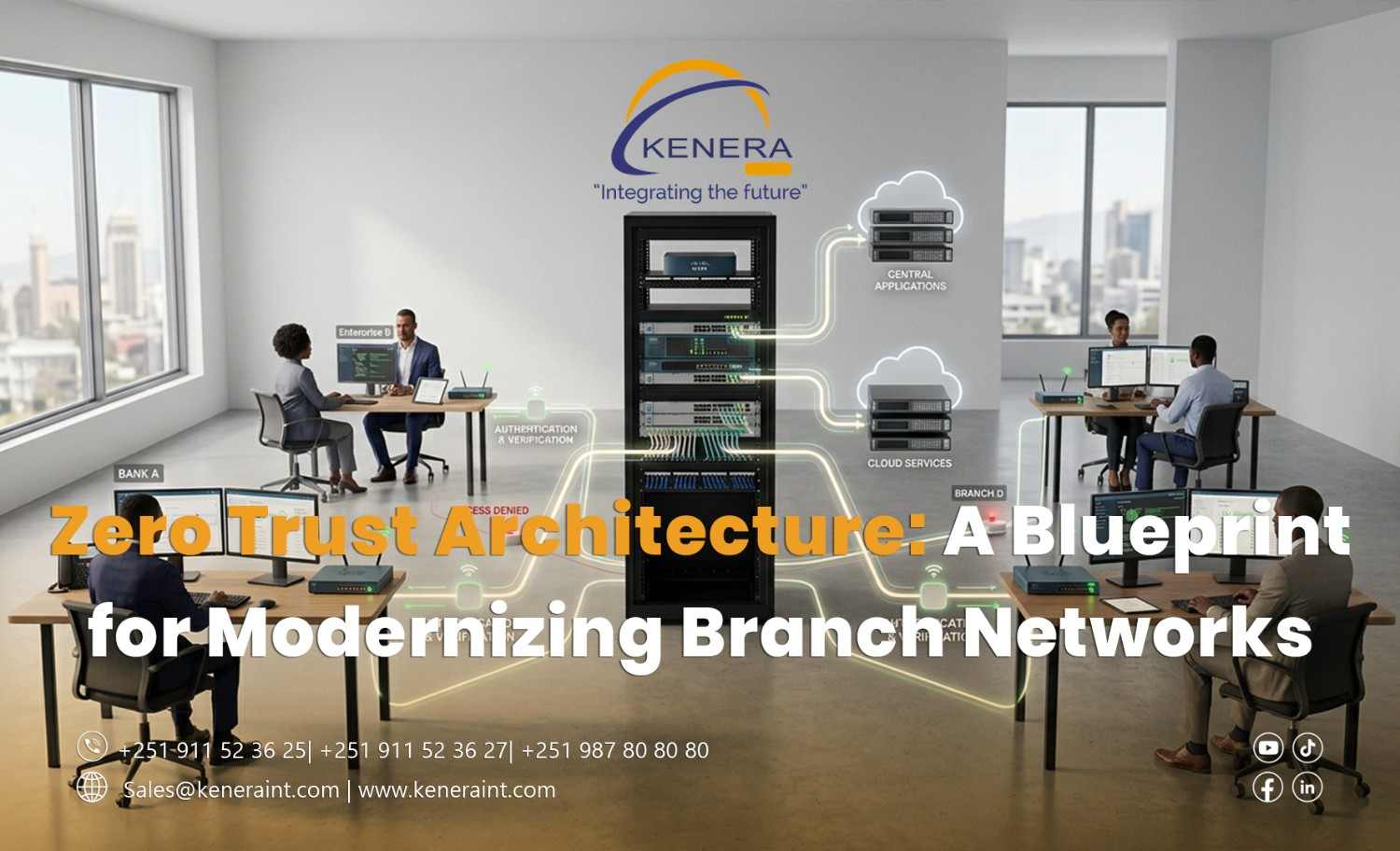
Zero Trust Architecture: A Blueprint for Modernizing Branch Networks
A new employee joins a regional branch on Monday morning.
They connect a laptop to the office network, receive an IP address, and suddenly sit inside the same environment used by printers, business applications, employee devices, and potentially sensitive systems.
The laptop is company-owned. The employee has a valid username.
But should those two facts automatically create trust?
That question sits at the center of Zero Trust Architecture (ZTA).
As Ethiopian organizations connect more branches, cloud applications, remote employees, and digital services, the traditional idea of a trusted internal network becomes harder to defend. Modern branch security needs to focus less on where someone connected and more on who they are, what device they are using, and what resource they actually need.
The Old Branch Network Had a Clear Border
Traditional branch networks were relatively predictable.
Employees worked inside the office. Applications were hosted in a central data center. Internet traffic passed through controlled gateways, and the network perimeter separated trusted internal users from the outside world.
That model has changed.
A branch employee might now use Microsoft 365, a cloud-hosted ERP, an internal application at headquarters, video conferencing, and SaaS platforms—all during the same morning.
Traffic is no longer moving toward one destination.
Security cannot depend entirely on one perimeter either.
Zero Trust Starts With Identity
Zero Trust is often summarized as “never trust, always verify,” but implementing it requires more than repeatedly asking users for passwords.
Access decisions can consider multiple signals.
An accountant in a branch office may need the financial system but have no reason to reach network-management interfaces.
A receptionist may need specific business applications without needing direct access to internal servers.
That is a very different model from simply allowing broad access because both employees are connected to the company LAN.
Segment the Branch Before an Incident Does It for You
A flat network can allow one compromised device to create risk for systems that should never have communicated with it.
Network segmentation helps reduce that exposure.
Employee devices, guest Wi-Fi, IP cameras, printers, voice systems, servers, and network-management interfaces can be separated according to their functions and security requirements.
Policies then determine what communication is actually necessary between them.
This does not mean creating dozens of VLANs without a plan. Segmentation should reflect business requirements and be supported by appropriate firewall policies, access controls, monitoring, and documentation.
The objective is simple: compromise of one area should not automatically provide a path to everything else.
Treat the Device as Part of the Login
A correct password does not prove that a device is safe.
Imagine an employee signing in from a laptop that has missed security updates, disabled endpoint protection, or been infected with malware.
Identity is valid.
The device may not be.
Modern Zero Trust branch security can incorporate device posture into access decisions. Depending on the technologies deployed, organizations may evaluate device ownership, software status, endpoint security, certificates, or compliance before permitting access to sensitive resources.
Access can become contextual rather than permanent.
Modernization Does Not Require Replacing Everything at Once
Zero Trust should not become another massive IT project that remains on a presentation slide for three years.
Organizations can modernize progressively.
Start by identifying critical applications and users. Strengthen identity with MFA. Review excessive privileges. Separate guest and unmanaged devices. Segment critical systems. Improve endpoint visibility. Centralize logs. Then introduce more granular access policies as the environment matures.
Each step should solve a real security problem.
The goal is not to purchase something called “Zero Trust.”
The goal is to build an architecture where trust is continuously earned and access is deliberately limited.
Build Branches for the Way Business Works Now
Modern branches are no longer isolated extensions of headquarters.
They are access points to cloud services, corporate applications, data centers, internet resources, and increasingly distributed workforces.
Their security architecture needs to reflect that reality.
Modernize Branch Networks with Kenera International
Kenera International helps organizations design and modernize enterprise network and cybersecurity environments around secure connectivity, segmentation, identity, visibility, and scalable infrastructure.
Because the future branch network should not ask:
It should ask: