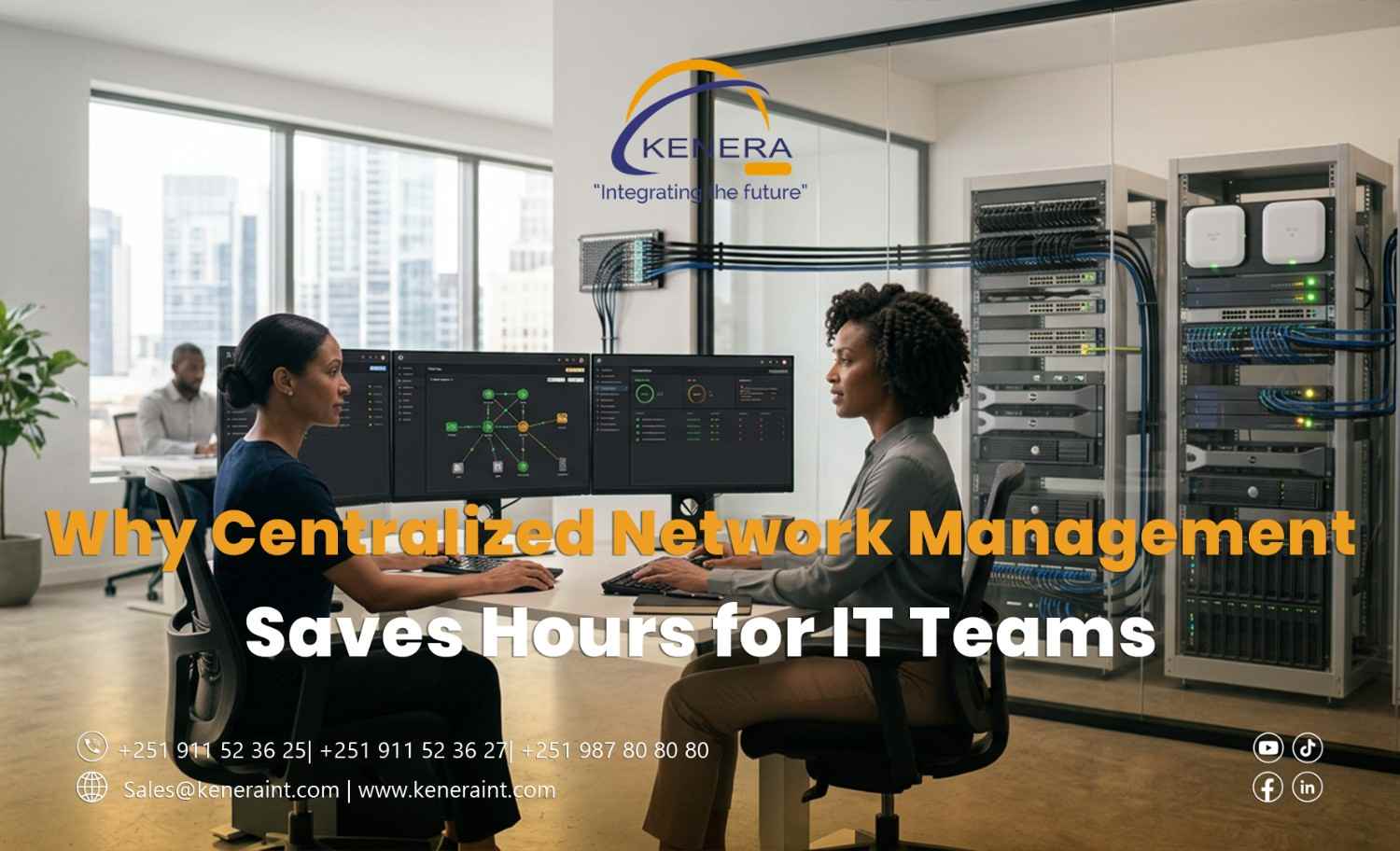
Why Centralized Network Management Saves Hours for IT Teams
It is 8:40 AM, and three branch offices report network problems.
One has unstable Wi-Fi. Another cannot reach a business application. At the third, several access points suddenly appear offline.
The IT team starts investigating.
First, they find the IP address of each device. Then they locate login credentials. They connect to individual switches, routers, firewalls, or access points. Someone calls an employee at the branch to check whether a cable is connected.
An hour disappears before the real troubleshooting even begins.
This is exactly the type of operational problem centralized network management is designed to reduce.
Stop Managing the Network Device by Device
Managing ten network devices individually may be possible.
Managing hundreds across headquarters, branches, warehouses, campuses, or other facilities is a different problem.
Without centralized visibility, engineers may repeatedly move between separate interfaces just to answer basic questions:
Which devices are online? Which access point has the most clients? Where is bandwidth being consumed? Is a switch port down? Which device is running an older configuration?
A centralized network management platform can bring supported infrastructure into a common management environment, allowing IT teams to spend less time finding information and more time acting on it.
See the Problem Before Opening Five Tools
Users often become the monitoring system for poorly managed networks.
“The internet is slow.”
“The Wi-Fi keeps disconnecting.”
“The application isn't opening.”
By the time the IT team receives the call, the problem has already affected work.
Centralized monitoring can provide visibility into device status, connectivity, traffic, performance, and alerts depending on the platform and equipment being managed.
Instead of beginning every incident from zero, engineers can start with useful context.
If several access points at one branch disappear simultaneously, for example, the problem may not be the individual access points. A shared switch, uplink, power source, or upstream connection could be involved.
Seeing the environment together makes patterns easier to identify.
One Configuration Mistake Can Become 30 Tasks
Imagine an organization needs to make the same approved configuration change across 30 network devices.
Doing that manually creates two costs.
The first is time.
The second is inconsistency.
The first is time.
The second is inconsistency.
An engineer may configure 29 devices correctly and accidentally miss one setting on the thirtieth.
Depending on the management platform and network architecture, centralized tools can help standardize configurations, templates, policies, software management, or deployment workflows.
That reduces repetitive administration while helping branches follow a more consistent network design.
Remote Branches Should Not Require Constant Travel
For organizations operating across multiple locations, every network issue cannot become a site visit.
Travel adds delay, transportation cost, and engineering time.
With appropriate remote management capabilities, IT teams can investigate many issues without physically standing beside the equipment.
They may be able to examine device health, interfaces, connected clients, logs, configuration information, or alerts remotely.
Physical visits will still be necessary for hardware failures, cabling problems, power issues, and certain installations.
But engineers should travel because the problem requires hands-on work—not because they lack visibility.
Troubleshooting History Matters
Some network problems disappear before an engineer investigates them.
A connection fails at 2:15 PM and returns at 2:19 PM.
Everything looks normal when IT checks at 2:30.
Without historical information, the incident becomes difficult to explain.
Centralized monitoring platforms can provide logs, alerts, performance history, and other records that help engineers investigate what happened before the network recovered.
That turns troubleshooting from guessing into evidence-based analysis.
Give Engineers Their Time Back
Centralized network management is not valuable simply because it creates a beautiful dashboard.
Its real value is operational.
Less time logging into devices individually. Less time searching for basic information. Less repetitive configuration work. Faster visibility across branches. Better historical troubleshooting. Fewer unnecessary site visits.
Modernize Network Management with Kenera International
Kenera International helps organizations design and modernize enterprise network environments with centralized visibility, secure connectivity, scalable infrastructure, and effective network management in mind.
Because as a network grows, adding more devices should not automatically mean adding more hours of manual work.