
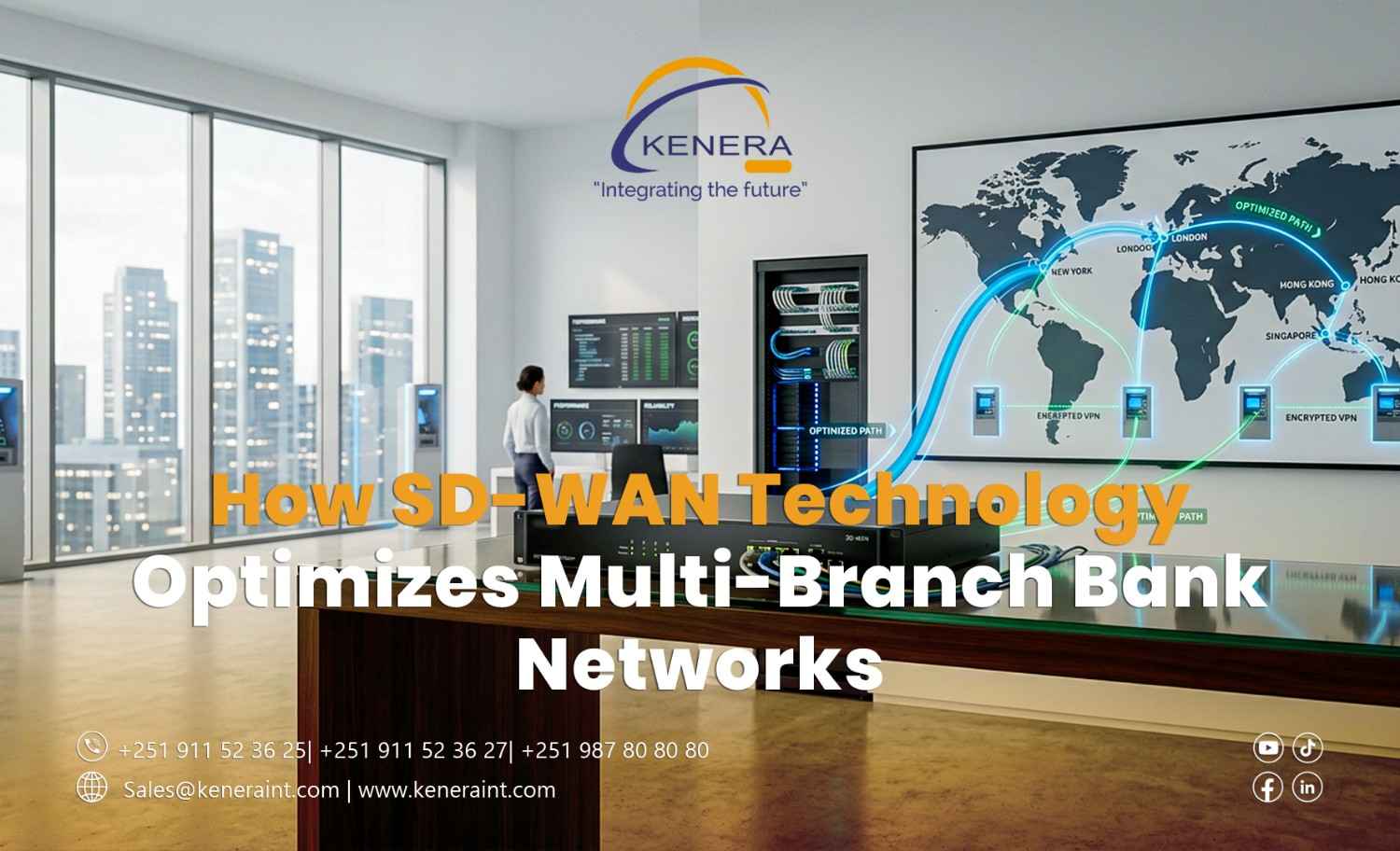
How SD-WAN Technology Optimizes Multi-Branch Bank Networks
Modern banking no longer happens in one building or through one network connection. A bank may operate dozens or hundreds of branches while simultaneously supporting ATMs, digital banking platforms, cloud applications, payment systems, contact centers, remote employees, security platforms, and data centers.
Every branch depends on reliable connectivity.
Yet many banks still operate wide area networks built around traditional architectures that can become expensive, difficult to scale, and increasingly complex as digital services expand.
This is where Software-Defined Wide Area Networking (SD-WAN) is changing the way financial institutions approach branch connectivity.
SD-WAN gives banks greater visibility and centralized control over their WAN infrastructure while intelligently directing application traffic across available network connections. Instead of treating every application and connection the same way, banks can create policies that prioritize critical financial services, improve resilience, strengthen security controls, and simplify the management of geographically distributed branches.
For banks expanding their physical and digital presence, SD-WAN can become an important foundation for building a more agile, secure, and reliable network.
Why Traditional Bank WAN Architectures Are Becoming More Difficult to Manage
For years, many enterprises connected remote locations to centralized data centers using technologies such as MPLS.
This architecture made sense when most applications and data lived inside the organization's own infrastructure. Branch traffic could be sent through the corporate data center before accessing business applications or external services.
Banking environments have changed dramatically.
Today's branch may need simultaneous access to:
- Core banking platforms
- Payment processing systems
- ATM infrastructure
- Cloud and SaaS applications
- Customer relationship management platforms
- Voice and video communication
- Cybersecurity services
- Regulatory and operational systems
- Internet and mobile banking infrastructure
Sending all of this traffic through rigid, centralized network paths can introduce unnecessary latency and create network bottlenecks.
Adding a new branch can also require significant configuration, coordination, and network engineering work.
SD-WAN introduces a more flexible approach.
What Is SD-WAN?
SD-WAN is a software-defined networking technology designed to simplify and optimize connectivity across geographically distributed locations.
Instead of managing each branch router independently, network administrators can centrally define policies governing how traffic should move across the WAN.
An SD-WAN environment can use multiple connectivity options, including:
The SD-WAN platform continuously evaluates available network paths and can select the most appropriate connection based on application requirements and predefined business policies.
For a bank, this means network decisions can be based on what actually matters to the business.
A payment transaction, for example, can receive different network treatment from a software update or ordinary web browsing session.
Intelligent Application-Aware Traffic Routing
One of the biggest advantages of SD-WAN for banking networks is application-aware routing.
Traditional routing generally focuses on reaching a destination. SD-WAN can make more sophisticated decisions based on application identity, network conditions, business priority, and policy.
Imagine a branch simultaneously processing:
- Teller transactions
- VoIP calls
- Video conferencing
- Cloud backups
- Employee web traffic
- Security updates
These applications do not have identical performance requirements.
A delay in a background software update may have almost no operational impact. A delay affecting a real-time financial transaction could immediately affect employees and customers.
SD-WAN allows banks to establish policies that give mission-critical applications priority.
The network can evaluate factors such as:
Traffic can then be dynamically directed toward the network path capable of meeting the application's requirements.
The result is a WAN that responds intelligently to changing network conditions instead of relying entirely on static routing decisions.
Greater Branch Network Resilience
A network outage inside a bank branch can quickly become a business outage.
Teller systems may become unavailable. Payment processing can be interrupted. Employees may lose access to centralized applications, and customers can experience delays.
SD-WAN can reduce this risk by allowing multiple WAN connections to operate as part of the branch connectivity architecture.
For example, a branch might have:
If the primary connection begins experiencing severe packet loss or fails completely, SD-WAN can automatically redirect appropriate traffic through another available connection.
This creates an important advantage over architectures where backup connectivity exists but requires slower or more complicated failover mechanisms.
For financial institutions, faster network recovery can contribute directly to improved business continuity and service availability.
Centralized Management Across Multiple Bank Branches
Managing network infrastructure becomes significantly more complicated as a bank expands.
Consider a financial institution operating 100 branches.
Traditional administration may require engineers to repeatedly configure routers, access policies, routing rules, and network services across numerous locations.
SD-WAN changes the operational model by introducing centralized orchestration.
Network teams can define policies centrally and distribute them across appropriate locations.
This can make it easier to:
- Configure new branches
- Update routing policies
- Monitor WAN performance
- Identify connectivity problems
- Apply standardized network configurations
- Manage branch connectivity consistently
- Respond to changing business requirements
Instead of treating every branch as an isolated networking project, the bank can manage the WAN as a coordinated infrastructure environment.
Faster Deployment of New Bank Branches
Opening a new branch traditionally involves far more than installing computers and connecting them to the internet.
Network engineers may need to configure connectivity, establish secure tunnels, implement routing policies, integrate the branch with central infrastructure, and verify that security requirements have been correctly implemented.
SD-WAN can simplify this process through standardized deployment and zero-touch provisioning capabilities.
A compatible SD-WAN device can be delivered to the new branch and connected to available network services. Once authenticated, it can obtain centrally defined configurations and policies.
This significantly reduces the amount of manual configuration required at the branch.
For banks pursuing regional expansion, faster deployment can make network infrastructure less of a bottleneck when opening new locations.
Better Use of Available Bandwidth
Traditional WAN environments may have expensive connectivity resources that are not always used efficiently.
SD-WAN enables banks to combine different transport technologies and use them according to business requirements.
Instead of forcing almost every application through the same connection, traffic can be distributed intelligently.
| Banking Traffic | Possible SD-WAN Priority |
|---|---|
| Core banking transactions | Critical |
| Payment processing | Critical |
| Security systems | High |
| Voice communications | High |
| Business applications | Medium / High |
| General web browsing | Medium |
| Software updates | Low |
| Backup synchronization | Policy dependent |
The exact policy depends on the bank's architecture and operational requirements, but the principle remains the same:
Valuable network capacity should be allocated according to business importance.
This helps financial institutions extract greater value from their connectivity infrastructure.
Improved Cloud and SaaS Connectivity
Banking infrastructure is increasingly hybrid.
Some applications remain inside private data centers, while others may operate in private clouds, public cloud environments, or SaaS platforms.
Traditional branch architectures sometimes backhaul internet and cloud traffic through a central data center.
Branch → Headquarters/Data Center → Internet → Cloud Application
This additional routing can increase latency and consume valuable WAN bandwidth.
With an appropriately designed SD-WAN and security architecture, selected branch traffic can use more direct paths toward trusted cloud services while remaining governed by centralized policies.
This can improve the user experience for cloud-based applications and reduce unnecessary traffic across private WAN links.
SD-WAN Can Strengthen a Bank's Security Architecture
Banks cannot evaluate network performance separately from cybersecurity.
Financial networks carry highly sensitive information and provide access to critical infrastructure. Connectivity must therefore be designed with strong security controls.
Modern SD-WAN solutions may support capabilities such as:
- Encrypted WAN tunnels
- Network segmentation
- Centralized security policies
- Application visibility
- Secure branch connectivity
- Integration with firewalls and security platforms
- Identity and access technologies
- Threat detection integrations
Segmentation Is Particularly Valuable
A bank may want to separate traffic associated with:
If these environments are properly segmented, an incident affecting one network segment can be more effectively contained rather than automatically exposing unrelated systems.
Important: SD-WAN should not be considered a replacement for a comprehensive banking cybersecurity architecture.
It should operate alongside technologies and practices such as next-generation firewalls, secure access controls, endpoint protection, SIEM, identity security, vulnerability management, and continuous monitoring.
Supporting SASE and Zero Trust Strategies
The evolution of SD-WAN is also closely connected to Secure Access Service Edge (SASE) and Zero Trust architectures.
Traditional security models often assumed that users and devices located inside the corporate network could be trusted more than external users.
That assumption is increasingly risky.
Banks now operate across branches, cloud environments, remote users, third-party services, data centers, and internet-facing applications.
Zero Trust follows a different principle:
Never assume trust simply because a user or device is connected to the internal network.
Access should instead be continuously evaluated according to factors such as identity, device posture, application, context, and policy.
SD-WAN can provide the intelligent connectivity layer while technologies within a broader SASE architecture provide security services such as secure web gateways, Zero Trust Network Access, firewall-as-a-service, and cloud access controls.
Together, these technologies can help financial institutions build networks designed around users and applications rather than physical locations alone.
Greater Network Visibility for IT Teams
A network problem that cannot be seen clearly is difficult to troubleshoot.
Traditional WAN environments can force IT teams to investigate individual routers, links, service providers, and applications before identifying the actual cause of poor performance.
SD-WAN platforms can provide centralized visibility into network behavior.
Depending on the platform, engineers may be able to monitor:
- Application performance
- WAN utilization
- Link availability
- Latency
- Packet loss
- Jitter
- Branch health
- Traffic patterns
- Failover events
This visibility can dramatically improve troubleshooting.
Instead of simply receiving a report that "the banking system is slow," the network team can investigate whether the problem is associated with a specific branch, ISP connection, application, routing path, or broader infrastructure issue.
That reduces mean time to identify problems and can help IT teams respond more effectively.
Potential WAN Cost Optimization
Cost is another major reason enterprises investigate SD-WAN.
MPLS remains valuable for many environments, particularly where predictable private connectivity is required. However, depending entirely on premium private links across every branch can become expensive as an organization grows.
SD-WAN allows financial institutions to adopt hybrid WAN architectures.
A bank might combine:
Different connections can then be used according to application requirements, availability, risk, and business policy.
The objective does not necessarily have to be eliminating MPLS.
For many banks, a more practical objective is using each connectivity technology where it provides the greatest value.
This can create a better balance between network performance, resilience, scalability, and operating cost.
A Practical Multi-Branch Banking SD-WAN Architecture
A modern banking WAN can be designed as several interconnected layers.
Each branch connects through an SD-WAN edge platform supporting multiple WAN connections.
Connectivity may include MPLS, fiber, broadband, LTE, or 5G depending on location and availability.
Centralized orchestration manages routing policies, configurations, network health, and application priorities.
Firewalls, segmentation, encrypted connectivity, access controls, monitoring, and additional cybersecurity technologies protect network traffic.
Branches securely connect to core banking infrastructure, private data centers, disaster recovery environments, cloud platforms, and SaaS applications.
The result is an architecture capable of adapting dynamically while maintaining centralized operational control.
SD-WAN Is Particularly Valuable During Bank Expansion
For growing financial institutions, network complexity can increase rapidly.
Every additional branch introduces new connectivity, security, monitoring, support, and management requirements.
Without an architecture designed for scale, IT teams can eventually spend increasing amounts of time maintaining network complexity instead of improving services.
SD-WAN helps create a repeatable branch networking model.
Once connectivity, application priorities, security policies, monitoring requirements, and branch templates are established, those standards can be applied more consistently as new locations are deployed.
This makes SD-WAN not simply a networking upgrade, but potentially an important component of a bank's broader digital transformation strategy.
Important Considerations Before Implementing SD-WAN in Banking
Despite its advantages, SD-WAN deployment requires careful planning.
Understand current circuits, routing, dependencies, applications, and performance requirements.
Identify which banking applications require the highest availability and lowest latency.
Determine how SD-WAN integrates with firewalls, segmentation, identity systems, SOC monitoring, and other cybersecurity controls.
Avoid creating new single points of failure at branches or centralized infrastructure.
Two connections provide limited resilience if they ultimately depend on the same physical infrastructure.
Ensure the architecture supports applicable financial-sector security, privacy, audit, and data protection requirements.
Network teams must understand how to monitor, troubleshoot, secure, and maintain the new environment.
Technology alone cannot optimize a banking network. The architecture, policies, implementation, monitoring, and operational processes determine whether the deployment delivers its intended benefits.
Building Smarter Banking Networks with Kenera International
As banks modernize their services, branch connectivity must evolve alongside applications, cybersecurity, cloud adoption, and customer expectations.
A well-designed SD-WAN architecture can help financial institutions create networks that are more resilient, application-aware, scalable, manageable, and prepared for hybrid cloud environments.
For multi-branch banks, the biggest advantage is not simply replacing one WAN technology with another. It is gaining greater intelligence and control over how the entire branch network operates.
Kenera International supports organizations in designing and implementing modern ICT, networking, cybersecurity, data center, and digital infrastructure solutions aligned with their operational requirements and long-term growth.
From branch connectivity and enterprise networking to cybersecurity and resilient computing infrastructure, Kenera International helps organizations build technology environments designed for today's requirements and tomorrow's expansion.
Conclusion
Banking networks are becoming more distributed, more application-dependent, and more connected than ever before.
Traditional WAN architectures can struggle to provide the flexibility required by hundreds of applications, multiple connectivity providers, cloud services, geographically distributed branches, and increasingly demanding security requirements.
SD-WAN introduces a more intelligent approach.
Through dynamic path selection, application-aware routing, centralized management, multi-link resilience, segmentation, improved visibility, cloud optimization, and simplified branch deployment, financial institutions can transform their WAN from a static connectivity layer into an adaptive business infrastructure.