How Paper Document Management Exposes Offices to Data Leaks
A confidential document does not need to be hacked to become a data breach.
Sometimes, it only needs to be left beside a printer.
Think about a normal office day. An employee prints a customer record, signs it, and places it on a desk. Another document is photocopied and forgotten in the machine. Old financial records are moved into an unlocked cabinet. A sensitive file leaves the office inside someone's bag.
No malware. No sophisticated attacker. No compromised password.
Yet confidential information has already become difficult to control.
For Ethiopian organizations still heavily dependent on physical records, paper document management can create security risks that are easy to overlook.
The Printer Is an Unexpected Security Gap
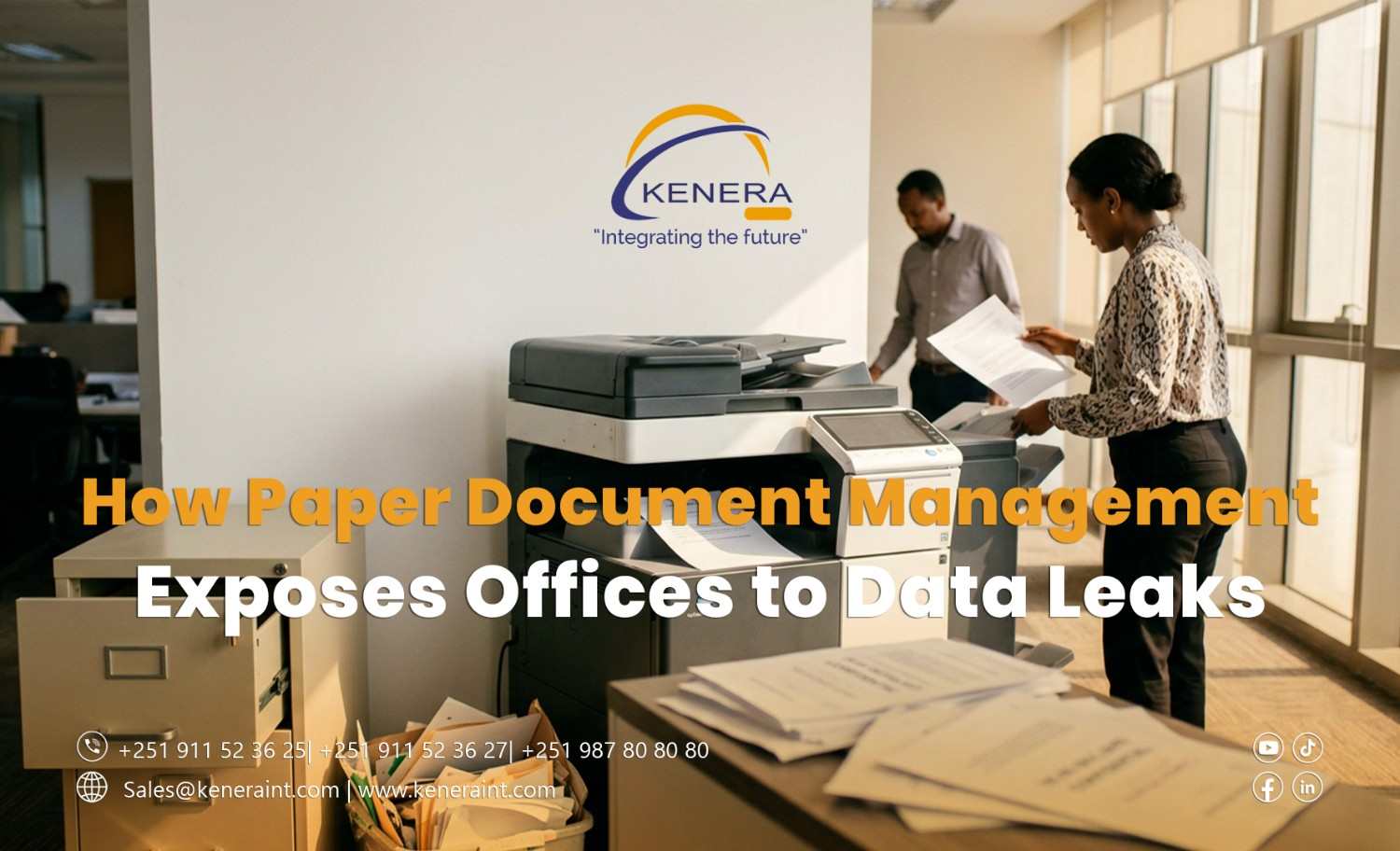
Shared printers are convenient—but they can become uncontrolled collection points for sensitive information.
Employees may print payroll information, contracts, customer records, invoices, HR documents, identification copies, or internal reports and collect them several minutes later.
During that time, anyone passing the printer may be able to see them.
Sometimes documents are never collected at all.
Secure printing features, where supported, can require users to authenticate before a document is physically released. But organizations should also establish clear policies about what information should be printed in the first place.
Photocopies Create Copies Nobody Tracks
Digital systems can maintain logs showing who accessed or modified a file.
Paper behaves differently.
One original document can become five photocopies within minutes. One goes to finance, another to management, another into an archive—and perhaps another remains forgotten on someone's desk.
Soon, nobody knows exactly how many copies exist.
This lack of visibility is one of the biggest weaknesses of physical document security.
Organizations cannot effectively protect sensitive information if they do not know where it is stored or how many copies exist.
Filing Cabinets Are Access Control Systems Too
Businesses spend heavily on passwords, firewalls, permissions, and authentication.
Then they store sensitive paper records in an unlocked cabinet.
Physical storage deserves the same security thinking as digital storage.
Confidential documents should be stored in controlled locations with access limited according to business need. Particularly sensitive archives may require locked cabinets, restricted rooms, documented access procedures, or other physical safeguards.
A filing room should not become a place where anyone can enter simply because the door happens to be open.
The Trash Bin Can Become a Data Leak
Throwing away paper does not destroy the information printed on it.
Customer details, employee records, quotations, financial information, passwords written during troubleshooting, network diagrams, and outdated contracts can remain readable after disposal.
Organizations therefore need a secure document disposal process.
Sensitive records that have reached the end of their required retention period should be destroyed appropriately rather than mixed with ordinary office waste.
Retention policies matter too. Keeping every document forever does not automatically make an organization safer.
Paper Makes Incident Investigation Difficult
Suppose a confidential digital file is accessed unexpectedly.
Depending on the system, administrators may be able to examine login records, timestamps, access logs, and other evidence.
Now suppose a confidential paper file disappears from an open shelf.
Who took it?
When?
Was it copied first?
Was it returned and then removed again?
There may be no reliable answer.
This is where digital document management systems can provide a significant advantage. Depending on the platform, organizations can implement permissions, document histories, centralized storage, search capabilities, backups, and access auditing.
Going Digital Does Not Mean Scanning Everything
Digital transformation is not simply purchasing a scanner and converting every cabinet into PDFs.
Organizations should first classify documents, define retention requirements, determine who needs access, establish approval workflows, secure storage, and decide how records will eventually be archived or deleted.
The goal is not merely paperless office transformation.
The goal is controlled information.
Modernize Information Management with Kenera International
Kenera International helps organizations modernize ICT environments and digital workflows with security, reliability, and long-term information management in mind.
Because protecting business data is not only about stopping hackers.
Sometimes cybersecurity begins with asking a much simpler question: