
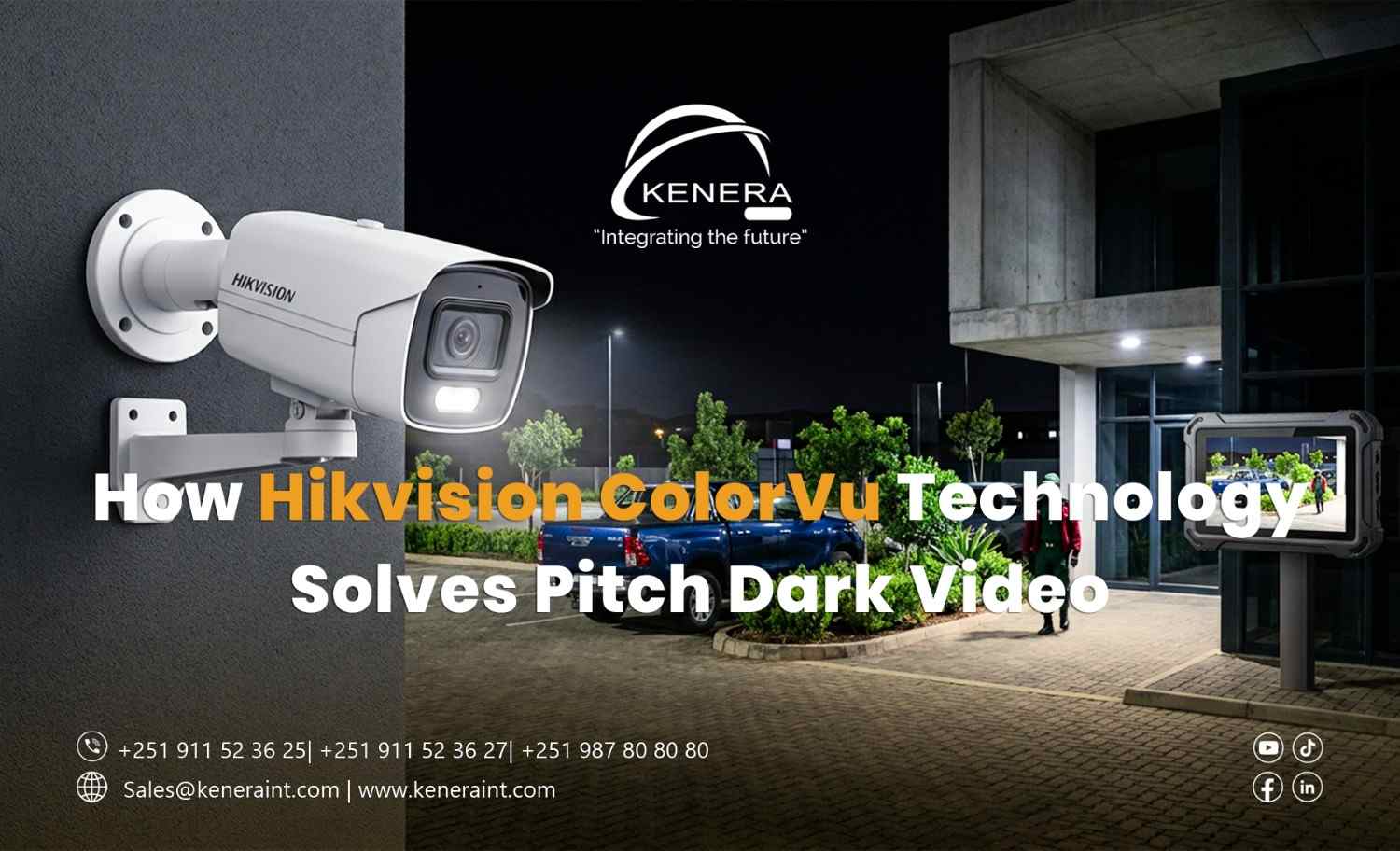
How Hikvision ColorVu Technology Solves Pitch Dark Video
It is 2:30 AM.
A security guard receives an alert from a warehouse surveillance system. Someone has entered the compound near the loading area.
The guard opens the CCTV recording.
A person is visible, but the footage is black and white. The vehicle beside them appears gray. The person's clothing is difficult to describe.
The camera recorded the incident, yet important visual information is missing.
This is a common limitation of conventional infrared night-vision surveillance.
Hikvision ColorVu technology addresses this challenge by capturing full-color video in extremely low-light conditions, helping security teams see details that traditional black-and-white night footage may not reveal.
1. Why Traditional CCTV Loses Color at Night
Most conventional security cameras depend on visible light to capture color images.
When illumination drops below a certain level, many cameras switch to infrared night vision.
Infrared illumination helps reveal objects and movement in darkness, but the resulting footage is typically black and white.
This creates a challenge when security teams need to identify details such as clothing colors, vehicle colors, or distinguishing features.
A camera may successfully record movement without capturing all the visual information needed for an effective investigation.
ColorVu approaches nighttime surveillance differently.
2. The F1.0 Lens: Capturing More Available Light
One of ColorVu's important technologies is its large-aperture lens.
Selected Hikvision ColorVu cameras use an F1.0 aperture, which allows more light to reach the image sensor than a narrower-aperture lens under comparable conditions.
Think of photographing a street at night.
A lens that captures more available light can produce a brighter image without depending entirely on artificial illumination.
ColorVu combines this optical advantage with sensitive imaging hardware to preserve color in environments where conventional cameras might switch to monochrome recording.
The result is improved low-light visibility without requiring bright floodlights throughout the property.
3. Advanced Sensors Turn Dim Scenes Into Useful Footage
A large lens alone cannot solve every nighttime imaging challenge.
The camera must also process the limited light reaching its sensor.
Hikvision ColorVu uses advanced image sensors and image-processing technology to improve brightness, reduce noise, and reproduce color.
This is particularly useful in environments with limited ambient lighting, including warehouse yards, office compounds, parking areas, and commercial building entrances.
Instead of producing a dark image with barely visible movement, a properly selected ColorVu camera can capture more recognizable visual details.
However, image quality still depends on the specific camera model, installation position, movement, and available illumination.
4. What Happens in Complete Darkness?
There is an important distinction between low light and absolutely no light.
ColorVu technology can make effective use of extremely small amounts of ambient illumination, but conventional color imaging still requires visible light.
In environments with no usable visible light, supported ColorVu cameras use supplemental white lighting to illuminate the scene and capture color footage.
Some models also offer Smart Hybrid Light, allowing different lighting modes depending on conditions and detected activity.
This means ColorVu should not be described as producing full-color video in complete darkness without any light source.
The camera's lighting capabilities and the site's actual conditions must be evaluated together.
5. Why Full-Color Night Surveillance Matters
Consider a logistics company investigating a nighttime security incident.
Traditional infrared footage might show a person approaching a parked vehicle.
Color footage could provide additional information, such as the color of the person's jacket or the vehicle involved.
These details can help security personnel review incidents and communicate observations more accurately.
For Ethiopian businesses operating warehouses, retail facilities, hotels, office compounds, and industrial properties, improved nighttime visibility can strengthen surveillance effectiveness.
Nevertheless, color imaging does not automatically guarantee identification. Camera resolution, viewing angle, subject distance, motion blur, and recording quality remain important.
6. Choosing the Right ColorVu Camera
Before upgrading an existing CCTV system, organizations should assess the environment rather than selecting cameras based on advertised features alone.
Important considerations include:
Lighting conditions: Determine whether ambient illumination is available or supplemental lighting will be required.
Coverage distance: Select suitable lenses and illumination ranges for entrances, perimeters, and open areas.
Recording requirements: Confirm compatibility with existing NVR systems, storage capacity, and network infrastructure.
Installation environment: Choose appropriate weather-resistant models for outdoor deployment.
Security configuration: Protect camera accounts, update firmware, and restrict unauthorized network access.
A well-designed surveillance system combines camera capabilities with correct positioning, reliable recording, and secure network connectivity.
See More Than Movement After Dark
Nighttime surveillance should provide useful evidence, not simply confirm that something happened.
Hikvision ColorVu technology improves low-light color imaging through advanced lenses, sensitive sensors, intelligent image processing, and supplemental lighting where needed.
Kenera International supports organizations in selecting and deploying professional CCTV and security infrastructure solutions designed around their operational environments and surveillance requirements.