
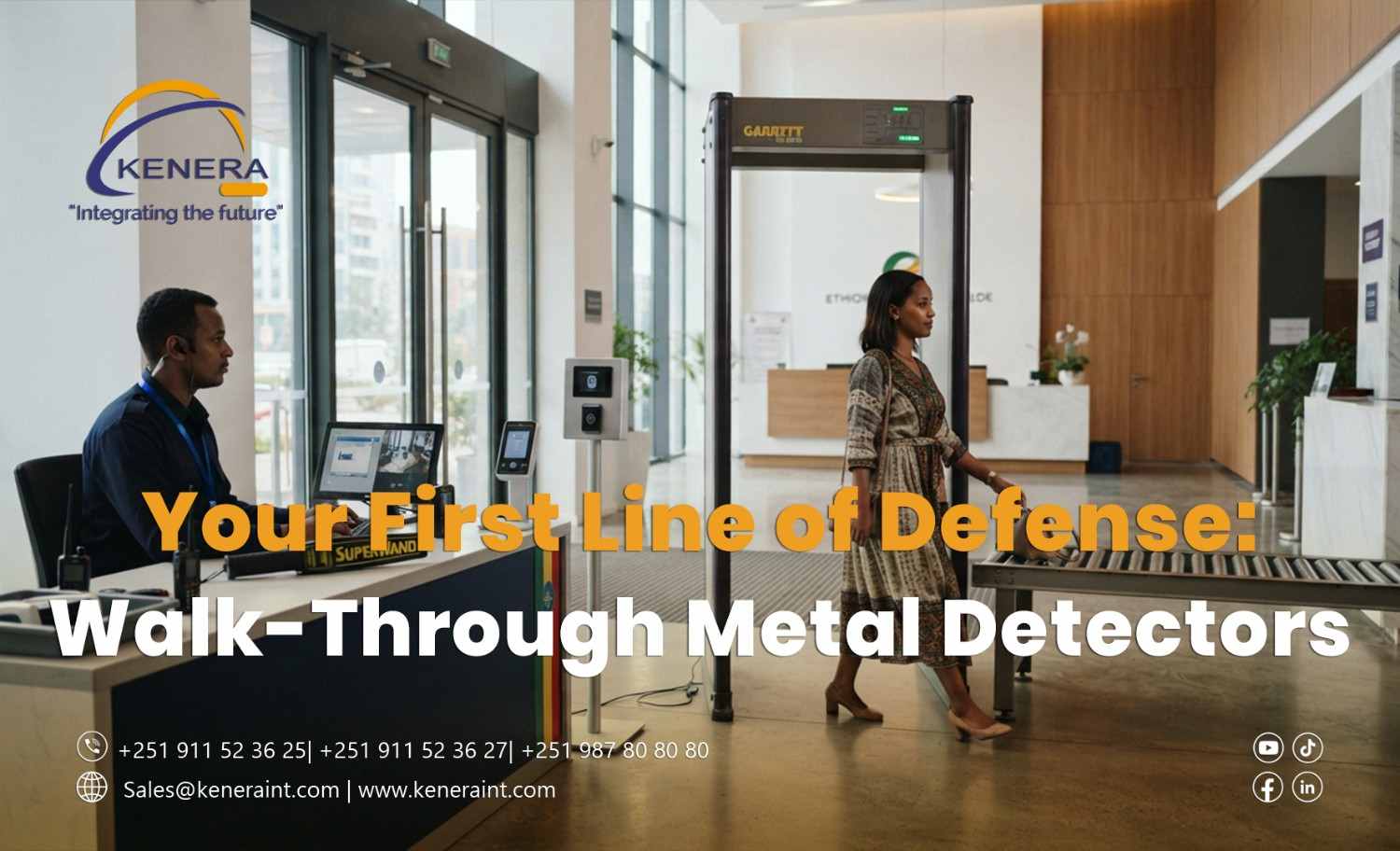
Your First Line of Defense: Walk-Through Metal Detectors
Physical security begins long before a visitor reaches a reception desk, office, or restricted area. For banks, government institutions, hotels, commercial buildings, and industrial facilities, the entrance is a critical point where security teams must assess potential threats while maintaining an orderly flow of people.
A walk-through metal detector provides an important layer of protection by screening individuals for concealed metallic objects before they enter a protected area. Unlike manual inspection alone, electronic screening can apply consistent detection settings across large numbers of visitors and alert security personnel when further investigation is necessary.
However, selecting and deploying a walk-through metal detector requires more than installing a screening gate at the entrance. Detection sensitivity, checkpoint design, alarm management, operator training, and maintenance all influence its effectiveness.
For organizations in Ethiopia investing in modern physical security infrastructure, understanding these factors is essential to building an entrance screening system that is reliable, practical, and appropriate for the facility's security requirements.
1. How Walk-Through Metal Detectors Work
Walk-through metal detectors use electromagnetic fields to detect metallic objects carried by individuals passing through a screening portal.
The detector generates an electromagnetic field and monitors changes caused by metal entering its detection area. When the response exceeds a configured threshold, the system activates an audible or visual alarm.
Depending on the equipment and its capabilities, the detector may respond to both ferrous metals, such as iron and steel, and non-ferrous metals, such as aluminum and copper.
Modern systems can include adjustable sensitivity, multiple detection zones, visual alarm indicators, and counters that record the number of people screened and alarms generated.
These functions help security teams conduct consistent screening and identify which areas require closer examination.
However, a metal detector does not automatically identify the exact object responsible for an alarm. A metallic personal accessory, electronic device, or prohibited item may produce a detection response.
The alarm indicates that additional screening is required.
The effectiveness of a walk-through metal detector therefore depends on both the detection equipment and the security procedures used to investigate alarms.
2. Multi-Zone Detection: Improving Screening Accuracy
One of the most important features to consider when evaluating a walk-through metal detector is its detection-zone capability.
Basic screening portals may provide a general alarm when metal is detected. More advanced models divide the screening area into multiple zones and provide an approximate indication of where the detected metal is located.
For example, a multi-zone detector may indicate that an alarm originated near the upper body, waist, or lower-leg area. Some systems provide additional left-side and right-side localization.
This information helps security personnel focus secondary screening on the relevant area rather than repeating a full inspection without guidance.
Multi-zone detection is particularly useful in facilities where large numbers of employees, customers, or visitors pass through security checkpoints each day.
However, the number of advertised detection zones should not be treated as the sole measure of equipment quality.
Organizations should also evaluate detection consistency, supported sensitivity settings, resistance to environmental interference, and results from relevant performance testing.
A detector with numerous zones is not necessarily more effective than another model simply because it advertises a larger number.
3. Balancing Detection Sensitivity and False Alarms
One of the biggest operational challenges in entrance screening is maintaining effective detection without creating unnecessary delays.
Metal detectors with highly sensitive settings may alarm on everyday objects such as keys, coins, belt buckles, or other metallic accessories.
While increasing sensitivity can improve the detection of certain smaller metallic objects, it can also increase nuisance alarms and the number of people requiring additional inspection.
Excessive alarms can create longer queues, increase the workload on security personnel, and reduce checkpoint efficiency.
On the other hand, reducing sensitivity merely to improve visitor throughput may increase the likelihood that relevant metallic objects pass through without triggering an alarm.
The appropriate setting depends on the facility's threat assessment, screening objectives, equipment capabilities, and approved security procedures.
For example, a government facility protecting restricted areas may require different screening arrangements from a commercial office receiving a high daily volume of visitors.
Security teams should work with qualified installers to establish appropriate detection settings and validate them through controlled testing.
Effective entrance security is not achieved by maximizing sensitivity or eliminating alarms. It requires reliable detection performance under realistic operating conditions.
4. Designing an Effective Security Screening Checkpoint
A walk-through metal detector is only one component of a complete entrance screening system.
The location of the portal, visitor circulation pattern, inspection space, and response procedures all influence checkpoint performance.
A properly designed screening area should provide adequate space for visitors to prepare for screening, pass through the detector individually, and complete any required secondary checks without blocking other people.
Security planners should also consider nearby metal structures, moving doors, electrical equipment, and other environmental conditions that could interfere with detection performance.
A typical checkpoint may incorporate several complementary technologies:
Walk-Through Metal Detector
Screens individuals for metallic objects as they pass through the portal.
Hand-Held Metal Detector
Supports targeted secondary screening when the walk-through system produces an alarm.
Baggage Screening Equipment
Provides a separate process for examining bags and carried belongings according to the facility's security requirements.
CCTV Surveillance
Supports observation, incident review, and coordination with security personnel.
Access Control System
Manages authorized entry into restricted areas after the required screening and verification procedures are completed.
These systems perform different functions and should be selected according to the facility's risk profile.
A walk-through metal detector cannot replace baggage inspection, identity verification, or access control. It is specifically designed for detecting metal, not every type of prohibited object or security threat.
5. Where Walk-Through Metal Detectors Are Used in Ethiopia
Organizations across Ethiopia operate facilities that require different levels of access control and physical security.
Walk-through metal detectors can support entrance screening in several environments.
Banks and Financial Institutions
Banks may use walk-through metal detectors at selected entrances to support security screening of visitors and employees. Equipment placement should be coordinated with customer service operations, emergency exits, and the institution's wider security arrangements.
Government Offices and Public Institutions
Government buildings that receive large numbers of visitors may require controlled entry points. Metal detection systems can support physical screening procedures alongside visitor registration, identification checks, and access authorization.
Hotels and Conference Facilities
Hotels, conference centers, and event venues may use screening equipment where justified by the event's or facility's security requirements. Checkpoint layouts should accommodate visitor volumes without creating unsafe congestion.
Industrial Facilities and Data Centers
Critical infrastructure facilities may require controlled access to sensitive operational areas. Walk-through screening can form part of a layered physical security strategy that also includes access credentials, surveillance, visitor management, and restricted-zone controls.
Educational Institutions and Event Venues
Where a documented risk assessment supports their use, screening systems may help institutions and event organizers manage controlled access during particular activities or high-attendance events.
The suitability of any deployment depends on the organization's security assessment, local requirements, and operating environment.
6. Key Features to Consider Before Purchasing a Walk-Through Metal Detector
Choosing a metal detector solely on purchase price or the advertised number of detection zones can lead to operational problems.
Organizations should evaluate equipment against defined security and installation requirements.
| Feature | Why It Matters |
|---|---|
| Detection performance | Determines how reliably the detector responds to relevant metallic test objects |
| Multi-zone indication | Helps operators localize alarms for secondary screening |
| Adjustable sensitivity | Allows authorized personnel to configure detection settings |
| Audible and visual alarms | Communicates screening alerts to security personnel |
| People and alarm counters | Supports basic checkpoint activity monitoring |
| Interference resistance | Helps maintain consistent operation in the installed environment |
| Power requirements | Determines compatibility with available electrical infrastructure |
| Access to configuration settings | Helps prevent unauthorized changes to detector operation |
| Maintenance and support | Supports ongoing equipment reliability and fault resolution |
Where relevant, buyers should request documented performance-test results and evaluate applicable standards, such as the National Institute of Justice's NIJ Standard-0601.02 for walk-through metal detectors.
They should also confirm equipment dimensions, environmental operating limits, warranty conditions, spare-part availability, and technical support arrangements.
Before purchasing multiple units, a practical on-site demonstration can help establish whether the proposed equipment meets the facility's screening objectives.
7. Installation, Calibration, and Preventive Maintenance
Even a capable walk-through metal detector can perform poorly if it is installed incorrectly or operated without consistent maintenance.
Installation should begin with a site assessment that considers available space, power supply, environmental interference, and visitor movement.
Once installed, the equipment should be configured according to the manufacturer's instructions and the facility's approved screening requirements.
Security personnel should conduct prescribed functional checks using suitable test objects and documented procedures. Tests should verify that the portal produces the expected alarms under the approved operating configuration.
Operators should also be trained to recognize equipment faults, manage alarms, conduct appropriate secondary screening, and report unusual conditions.
Preventive maintenance should include inspection of the detector's physical condition, verification of operating status, authorized configuration reviews, and software or firmware maintenance where supported.
Where electrical interruptions are a concern, organizations should evaluate suitable power protection or backup arrangements based on the equipment's specifications.
A metal detector should not be considered operationally reliable simply because its display is powered on.
Reliable security screening requires verified detection performance, trained personnel, and consistent operating procedures.
8. Integrating Metal Detection into a Layered Physical Security Strategy
No single security device can protect an organization against every physical threat.
Walk-through metal detectors are effective only within the limits of their detection technology and the procedures surrounding their use.
A facility that installs a metal detector but leaves an adjacent entrance uncontrolled may undermine its intended screening process.
Similarly, an entrance with advanced detection equipment but no clear alarm-response procedure may struggle to handle security incidents consistently.
For this reason, organizations should approach entrance screening as part of a broader physical security architecture.
This involves evaluating pedestrian access points, perimeter protection, CCTV coverage, visitor verification, restricted-area authorization, and security staff responsibilities.
Checkpoint procedures should also provide appropriate accommodations for individuals who cannot use conventional walk-through screening, including those with relevant medical devices or mobility requirements. Alternative screening should follow applicable policies and equipment guidance.
Periodic security assessments can help organizations identify gaps between the intended screening process and actual daily operation.
The goal is to establish a controlled entrance where technology, personnel, and procedures work together.
Strengthen Entrance Security with Kenera International
For Ethiopian organizations, selecting the right walk-through metal detector involves balancing security requirements, detection performance, operational efficiency, and long-term equipment reliability.
Whether deployed at a bank, government institution, hotel, corporate office, or critical infrastructure facility, a properly configured metal detection system can provide an important first layer of physical security screening.
However, the greatest value comes from integrating the equipment into a complete checkpoint design supported by trained personnel, clear procedures, and appropriate complementary security technologies.
Kenera International Trading PLC supports organizations seeking modern physical security, surveillance, access control, and enterprise ICT solutions.
From equipment selection and infrastructure planning to the integration of complementary security technologies, Kenera helps organizations evaluate solutions that align with their operational and physical security needs.