
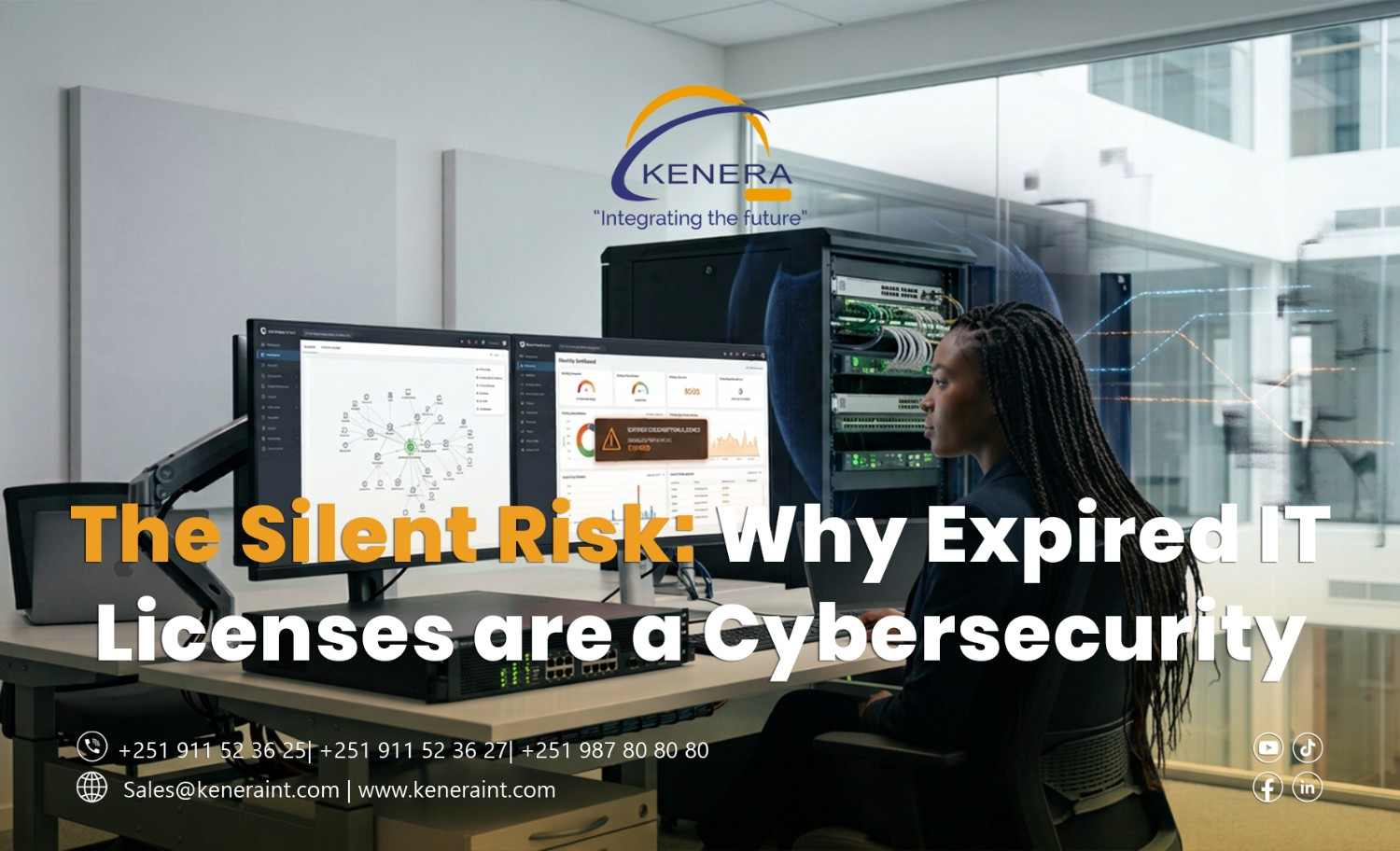
The Silent Risk: Why Expired IT Licenses Are a Cybersecurity Time Bomb
Nothing crashes when an IT license expires.
The firewall may continue filtering traffic. The server keeps running. Employees still open applications. Everything appears normal.
That is exactly what makes an expired IT license dangerous.
Behind the scenes, an organization may have stopped receiving security updates, threat intelligence, vendor support, cloud security services, or other protections tied to an active subscription. The infrastructure is still operating—but its ability to defend itself may be quietly weakening.
For Ethiopian organizations managing growing digital environments, license management should therefore be treated as part of cybersecurity, not simply procurement administration.
Expired Does Not Always Mean “Stopped”
Many businesses expect licensed technology to stop working immediately when its subscription expires.
Enterprise technology is often more complicated.
Depending on the vendor and product, a firewall, server application, endpoint security platform, backup solution, or network management system may retain some functionality after expiration while losing access to specific services.
That creates a dangerous illusion: working does not necessarily mean fully protected.
For example, a security appliance may continue passing network traffic while certain threat-prevention services or updates are no longer available under an expired subscription.
The exact behavior varies by product, making it important for IT teams to understand what each license actually enables.
Yesterday's Protection Is Not Enough
Cybersecurity changes continuously.
New vulnerabilities are discovered. Malware evolves. Attack infrastructure changes. Vendors release patches, detection signatures, reputation data, and security improvements to respond.
An organization relying on outdated protection is effectively trying to recognize today's threats using yesterday's information.
Consider an internet-facing security system that has not received relevant updates for months.
Nothing about the hardware itself may look broken. There may be no dramatic warning visible to employees. Yet the gap between current threats and the organization's defensive capabilities can continue growing.
That is why IT license renewal can have a direct relationship with security posture.
The Forgotten License Problem
The biggest danger is sometimes not intentionally avoiding renewal.
It is forgetting the license exists.
Modern organizations can accumulate dozens of subscriptions across firewalls, endpoint protection, operating systems, backup platforms, virtualization environments, monitoring systems, productivity tools, databases, and cloud services.
Renewal dates become scattered across emails, spreadsheets, procurement records, and different departments.
Then the employee who originally purchased a product leaves.
Three months later, someone discovers the subscription expired.
This is less a technology failure than an IT asset and license management failure.
Support Can Disappear When You Need It Most
Imagine discovering a serious infrastructure problem at 10:00 AM on a working day.
Your engineers investigate but determine that vendor assistance is required.
Then they discover the support contract expired.
Organizations may lose access to certain technical support, replacement services, software downloads, upgrades, or other vendor resources depending on their agreement.
An expired support entitlement can therefore turn an already stressful incident into a slower recovery process.
The cost of renewal suddenly looks very different when critical business services are unavailable.
Build a License Radar
Organizations do not need to wait for expiration emails.
Create a centralized register containing each critical product, license type, responsible owner, renewal date, vendor or supplier, support level, and business system it protects.
Then introduce alerts well before expiration—such as 90, 60, and 30 days.
More importantly, classify licenses by business impact.
A subscription protecting a production firewall deserves different attention from a rarely used application on an isolated workstation.
This allows IT and procurement teams to prioritize renewals based on actual operational and cybersecurity risk.
Treat Licenses Like Security Infrastructure
Businesses carefully monitor server temperatures, storage capacity, internet connections, UPS batteries, and firewall availability.
Critical software and security entitlements deserve similar visibility.
Manage ICT Infrastructure Beyond the Hardware
Kenera International helps organizations build and maintain enterprise ICT environments with attention to infrastructure lifecycle, cybersecurity, licensing, support, and operational continuity.
Sometimes everything stays green—while an important layer of protection has already expired.