
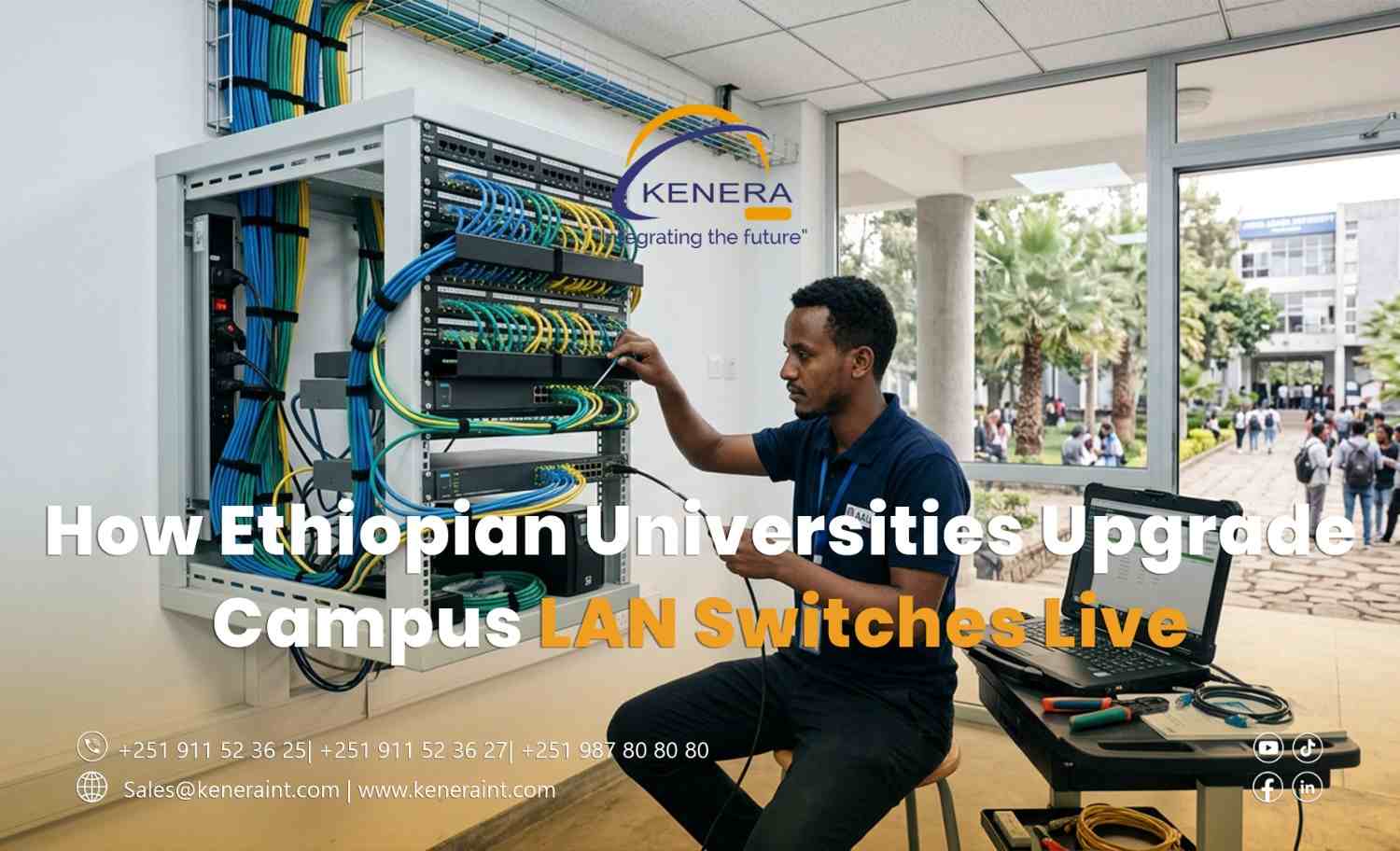
How Ethiopian Universities Upgrade Campus LAN Switches Live
Digital learning is transforming university campuses across Ethiopia. Students and staff increasingly depend on online learning platforms, digital libraries, cloud applications, video conferencing, Wi-Fi, research systems, and connected administrative services.
Behind these technologies is a critical infrastructure component that often receives less attention: the campus LAN switching network.
As bandwidth requirements increase and older switches reach their limits, Ethiopian universities need to modernize their networks without unnecessarily disrupting teaching, administration, or internet access.
A carefully planned live LAN switch upgrade can improve performance, resilience, security, and scalability without requiring the entire campus network to be taken offline.
Why Campus LAN Switch Upgrades Matter
Legacy switches may continue operating for years, but older hardware can eventually become a bottleneck.
Limited port speeds, restricted uplink bandwidth, insufficient PoE capacity, and older security capabilities can constrain campus services.
Higher bandwidth, improved reliability, stronger management, scalable uplinks, and better support for expanding digital infrastructure.
Modern universities may connect thousands of devices across academic, administrative, residential, and operational environments.
Upgrading to modern enterprise LAN switches provides higher capacity, improved reliability, stronger network management, and better support for expanding digital services.
Assess the Existing Campus Network
Before replacing equipment, universities should develop an accurate picture of their existing infrastructure.
Network teams can document VLAN configurations, uplinks, connected devices, fiber connections, PoE requirements, and critical services before migration begins.
Traffic analysis can also reveal heavily utilized links and areas where additional capacity is required.
Why this matters: A detailed assessment helps engineers determine which switches should be replaced first and prevents important configurations or dependencies from being overlooked during migration.
Design the New LAN Architecture
A successful university network upgrade in Ethiopia should consider both current requirements and future growth.
Depending on campus size, the architecture may include high-capacity core switching, resilient distribution layers, and managed access switches across faculties, libraries, laboratories, dormitories, and administrative buildings.
Capabilities for a Modern Campus Network
PoE-capable switches are particularly useful for powering wireless access points, IP phones, and surveillance cameras directly through Ethernet infrastructure.
Upgrade Switches Without Major Disruption
Replacing every switch simultaneously can create unnecessary operational risk. A phased migration provides greater control.
Universities can begin with less critical buildings or network segments before progressing toward high-priority academic and administrative areas.
Configurations should be prepared and validated before equipment is connected to the production network. Engineers can then migrate network links and endpoints in controlled groups while monitoring connectivity.
Choose Lower-Impact Upgrade Windows
Scheduling critical changes during lower network utilization periods further reduces the potential impact on students, faculty, and administrative operations.
Test Connectivity After Migration
Testing is essential during every phase of a campus LAN switch upgrade.
Network teams should confirm that critical services remain reachable and that migrated users and devices operate as expected before moving to the next network segment.
Monitor the New Switches
Maintaining configuration backups and documented rollback procedures also provides an important recovery option if unexpected problems occur.
Live-upgrade principle: migrate a controlled section, validate it, monitor it, and only then proceed to the next section of the campus.
Strengthen Security During the Upgrade
A LAN modernization project provides an opportunity to improve campus cybersecurity rather than simply replacing old hardware with faster equipment.
Universities can strengthen network segmentation between different user groups, systems, and connected devices.
Modern Switching Security Controls
These controls can help universities reduce unauthorized access, isolate different types of users and devices, and gain greater visibility across the campus infrastructure.
Building Future-Ready University Networks
Modern campus networks must support growing numbers of users, devices, applications, and digital learning services.
By assessing existing infrastructure, designing scalable architecture, migrating switches in phases, testing carefully, and strengthening security, Ethiopian universities can upgrade LAN infrastructure while keeping essential services available.
Modernize Campus Networks with Kenera International
Kenera International supports organizations in designing and implementing reliable networking and ICT infrastructure for modern digital environments.
A university LAN modernization project requires more than replacing switches. Existing infrastructure must be assessed, new architecture carefully designed, configurations prepared, migrations controlled, services tested, and network performance monitored throughout the transition.
With a properly planned approach, Ethiopian universities can modernize campus connectivity while protecting the availability of critical academic and administrative services.
A Smarter Path to Campus LAN Modernization
Campus networks are becoming increasingly important to the delivery of education, research, administration, communications, security systems, and digital services.
Universities do not necessarily need to choose between modernization and availability. A phased, carefully tested migration strategy allows aging switching infrastructure to be replaced while reducing unnecessary disruption to campus operations.
The strongest approach combines accurate network assessment, scalable architecture, preconfigured equipment, controlled migration, rigorous testing, stronger segmentation, and continuous monitoring.