
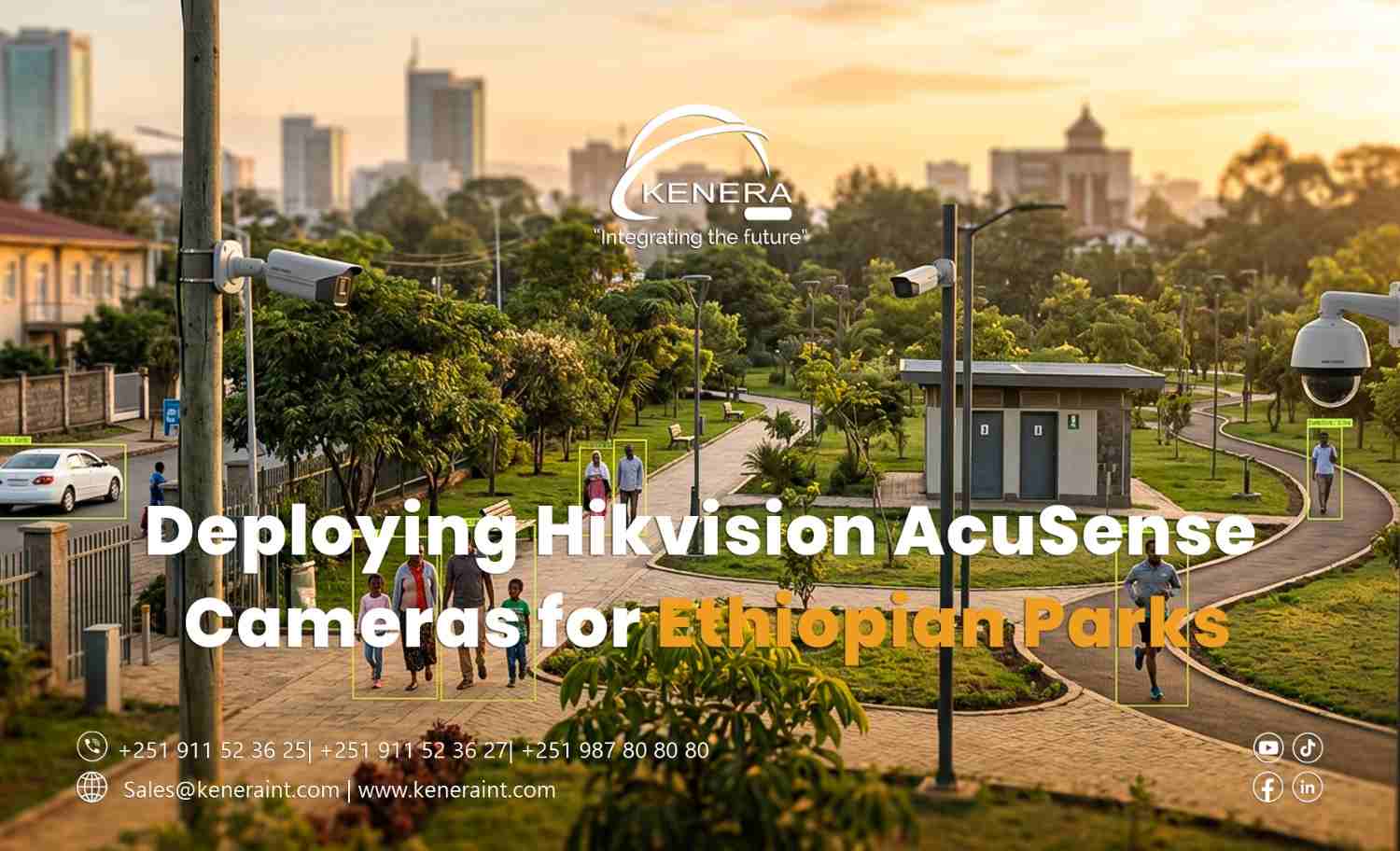
Deploying Hikvision AcuSense Cameras for Ethiopian Parks
Ethiopia’s urban parks are changing. Modern public spaces are no longer simply landscaped areas with benches and walking paths. They increasingly combine pedestrian routes, playgrounds, cafés, parking areas, event spaces, cycling tracks, gardens, and other public facilities.
As these environments become larger and busier, protecting them requires a surveillance strategy capable of understanding activity rather than simply recording it.
Hikvision AcuSense cameras offer an intelligent approach to park surveillance by helping security teams distinguish important events from everyday movement.
For Ethiopian parks, where vegetation, changing weather, pedestrians, vehicles, and nighttime activity can exist within the same environment, this distinction can make CCTV operations considerably more effective.
Why Conventional CCTV Can Struggle in Parks
A park is one of the most challenging environments for traditional motion detection.
Trees move in the wind. Shadows shift throughout the day. Birds cross camera views. Rain changes image conditions. At the same time, hundreds or thousands of legitimate visitors may move through monitored areas.
If every movement becomes an alarm, operators quickly receive more information than they can realistically investigate.
AcuSense changes this workflow by using deep-learning technology to classify people and vehicles separately from other moving objects.
Instead of treating movement itself as the security event, surveillance rules can focus on the type of activity that actually matters.
Example: A camera protecting a maintenance compound could prioritize a person entering after closing hours while ignoring movement from nearby vegetation.
Designing AcuSense Around the Park
Effective deployment begins with the park layout—not the camera quantity.
Every surveillance point should have a defined operational purpose based on the activity, risk, and security objective of that specific area.
At pedestrian entrances, cameras can provide clear observation of people entering and leaving. Around parking areas and service roads, AcuSense vehicle classification can help operators identify relevant vehicle activity without reviewing hours of unrelated footage.
Apply Different Detection Logic to Different Areas
Different security rules can be applied depending on the purpose of the monitored location.
A boundary beside a restricted facility can use line-crossing detection. Equipment areas can use intrusion zones. Administrative buildings can receive stronger after-hours protection, while public walkways remain monitored without generating unnecessary alerts from normal visitor movement.
This creates a layered surveillance architecture where each camera has a defined security purpose rather than simply adding cameras across the site without an operational strategy.
Addressing Ethiopian Environmental Conditions
Camera placement is particularly important in outdoor Ethiopian deployments.
Strong daytime sunlight can create difficult contrast between bright open spaces and shaded areas beneath trees or structures. Low-light conditions around pathways and perimeter zones create a different challenge after sunset.
Outdoor equipment must also be selected with dust, rain exposure, physical access, and seasonal environmental changes in mind.
Rather than placing cameras simply at the nearest available pole, installers should evaluate viewing angle, lighting direction, vegetation growth, mounting height, network connectivity, and the actual detection objective.
This engineering work directly influences how effectively intelligent analytics perform. AI-enabled surveillance still depends on thoughtful camera positioning and infrastructure design.
Turning Recorded Video Into Actionable Security
One of AcuSense’s strongest advantages for park operations appears after an incident occurs.
Traditional CCTV investigations may require security personnel to manually review long sections of video. AcuSense-compatible systems can categorize relevant human and vehicle events, helping operators narrow searches and retrieve useful footage faster.
Imagine security personnel investigating unauthorized vehicle access near a park service entrance at 2:00 a.m.
Instead of reviewing every motion event recorded overnight, operators can concentrate on vehicle-related events within the relevant period.
That difference can significantly improve incident response by helping operators move from large volumes of recorded footage toward the specific events most relevant to an investigation.
Building Smarter Park Surveillance in Ethiopia
Deploying Hikvision AcuSense cameras for Ethiopian parks should not be viewed simply as upgrading from conventional cameras to AI cameras.
The greater opportunity is redesigning how surveillance information is collected, filtered, stored, and used.
An effective deployment should combine appropriate camera positioning, AcuSense analytics, network infrastructure, recording systems, storage planning, and centralized monitoring into one coordinated surveillance architecture.
Deploy Intelligent Park Surveillance with Kenera International
Kenera International can help organizations develop intelligent video surveillance architectures that combine appropriate camera positioning, AcuSense analytics, network infrastructure, recording systems, storage planning, and centralized monitoring.
A successful surveillance environment depends on more than the camera itself. Network design, storage capacity, viewing angles, environmental conditions, detection rules, and monitoring workflows all influence the effectiveness of the final solution.
By approaching park surveillance as an integrated ICT and security infrastructure project, organizations can build systems designed around reliability, scalability, operational visibility, and real-world security requirements.
Conclusion
As Ethiopia invests in more modern public spaces, surveillance infrastructure should evolve alongside them.
A well-designed AcuSense deployment can help security teams spend less time watching irrelevant movement and more time responding to events that genuinely require attention.
By combining intelligent human and vehicle classification with thoughtful camera positioning, targeted detection rules, reliable networking, suitable recording infrastructure, and centralized monitoring, parks can develop a more practical and responsive surveillance environment.