
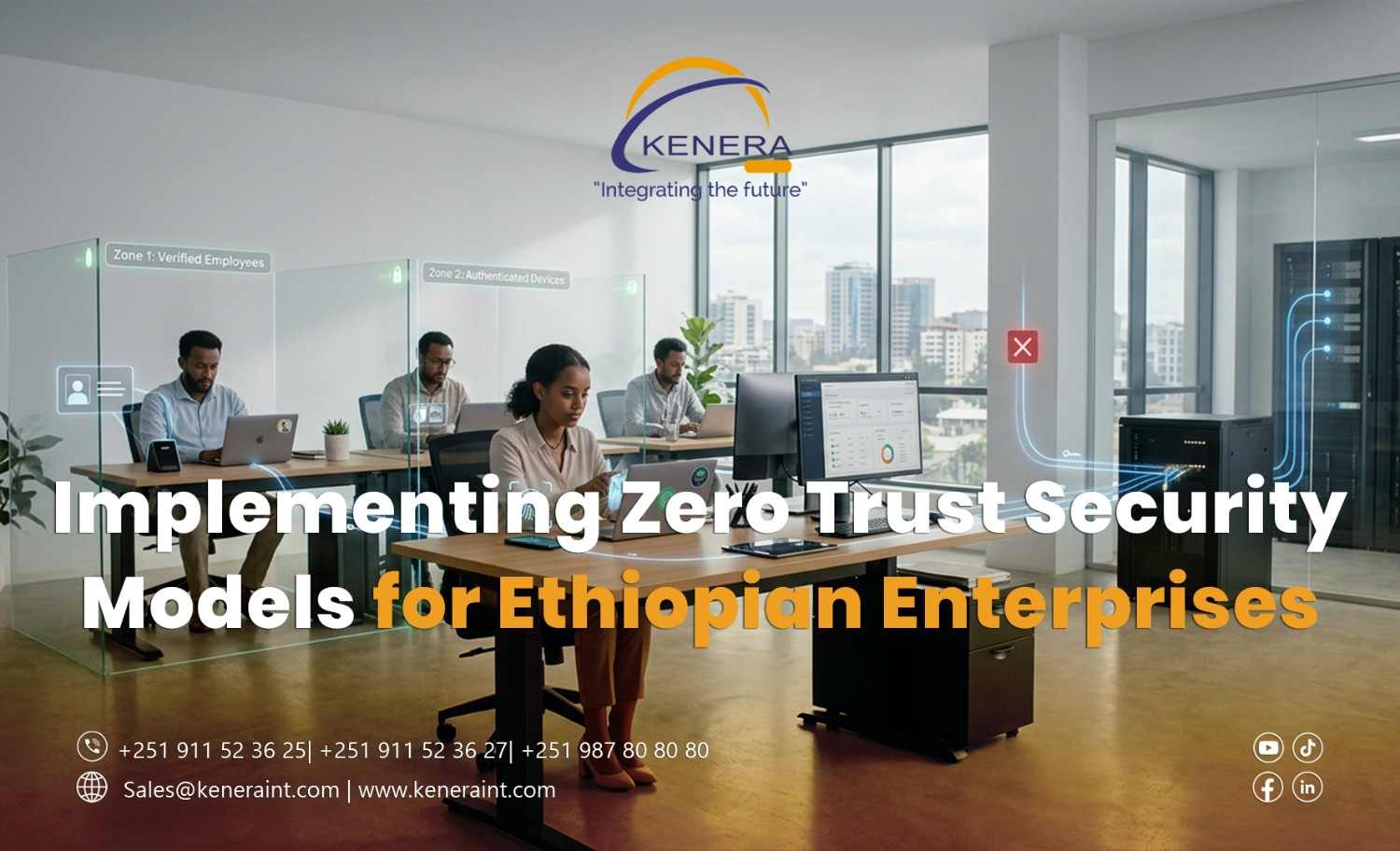
Implementing Zero Trust Security Models for Ethiopian Enterprises
As Ethiopian enterprises accelerate digital transformation, cybersecurity risks are becoming more complex. Organizations increasingly rely on cloud platforms, mobile devices, remote access, interconnected branches, enterprise applications, and third-party services.
While these technologies improve efficiency, they also expand the potential attack surface. Traditional security models often focus heavily on protecting the network perimeter. However, once a user or device gains access to the internal network, conventional architectures may provide significant levels of trust.
A Zero Trust security model takes a fundamentally different approach: never trust automatically and continuously verify access.
Access decisions should be based on verified identity, device security, permissions, and context—not simply network location.
For Ethiopian enterprises seeking stronger protection for critical systems and business data, Zero Trust provides a modern cybersecurity framework built around identity, visibility, controlled access, segmentation, and continuous verification.
Why Ethiopian Enterprises Need Zero Trust Security
Cyber threats can originate from many directions, including compromised credentials, phishing attacks, malware, unauthorized devices, third-party access, and insider threats.
At the same time, enterprise IT environments are becoming increasingly distributed. Employees may access applications from offices, regional branches, homes, mobile devices, and cloud environments.
Zero Trust helps organizations address this complexity by assuming that every access request should be evaluated regardless of where it originates.
Instead of automatically trusting users because they are connected to a corporate network, organizations verify their identity, device, permissions, and access context before allowing them to reach critical resources.
Strengthen Identity and Access Management
Identity is one of the foundations of Zero Trust architecture. Enterprises need to know exactly who is requesting access and whether that user should be permitted to reach the requested resource.
Organizations should implement strong Identity and Access Management (IAM) policies that ensure users receive only the permissions necessary for their responsibilities.
Role-based controls can restrict access to sensitive applications, databases, administrative systems, and infrastructure. The principle of least privilege further reduces risk by preventing unnecessary permissions from remaining available to users or accounts.
Segment Critical Enterprise Networks
Network segmentation is another important component of Zero Trust implementation.
Rather than operating one broadly trusted internal network, enterprises can separate critical environments into controlled security zones with different access policies.
Financial systems, data centers, employee networks, production infrastructure, guest networks, and sensitive databases can each operate under different security policies.
Microsegmentation can provide even more granular controls between workloads and applications.
If an attacker compromises one endpoint, effective segmentation can help prevent that compromise from becoming unrestricted lateral movement across the enterprise environment.
Continuously Monitor Users and Devices
Zero Trust is not simply a one-time authentication process. Trust conditions can change during a session, and security teams need visibility into what users and devices are doing throughout the environment.
Organizations should continuously evaluate users, devices, applications, and network activity for suspicious behavior.
Security monitoring platforms can help identify unusual login attempts, unexpected access patterns, compromised endpoints, or abnormal data movement.
Verify Device Security
Device security is equally important. A legitimate user connecting from a compromised or poorly secured endpoint may still create significant risk.
Enterprises should establish policies to verify that endpoints meet required security standards before they are allowed to access sensitive resources.
Combining endpoint protection, network visibility, identity monitoring, and centralized security analytics provides security teams with stronger situational awareness across the enterprise.
Implement Zero Trust Gradually
Moving toward Zero Trust does not require replacing an organization's entire IT infrastructure immediately.
A phased implementation allows Ethiopian enterprises to strengthen their highest-risk environments first and progressively extend Zero Trust controls as infrastructure and security capabilities mature.
Zero Trust should be treated as a security journey rather than a single technology deployment. Controls can be introduced progressively according to business priorities, risk, and existing infrastructure.
Building Secure Digital Enterprises in Ethiopia
As Ethiopia's digital economy expands, enterprises need cybersecurity architectures capable of adapting to evolving threats and increasingly connected environments.
A properly designed Zero Trust security model can help organizations reduce unauthorized access, limit the impact of compromised accounts, strengthen data protection, and improve visibility across enterprise systems.
The strongest approach combines identity security, controlled access, network segmentation, endpoint protection, and continuous monitoring into a coordinated security architecture.
Implement Zero Trust with Kenera International
Building an effective Zero Trust environment requires careful planning across identity, networking, endpoints, applications, monitoring, and existing enterprise infrastructure.
Kenera International helps organizations design and implement secure ICT and cybersecurity infrastructure aligned with modern business requirements.
By combining strong identity controls, network security, monitoring, segmentation, and carefully planned Zero Trust principles, we help Ethiopian enterprises build more resilient digital environments while supporting secure business growth and transformation.
Conclusion
The traditional concept of a trusted internal network is becoming increasingly difficult to maintain as enterprise infrastructure expands across branches, cloud environments, remote users, mobile devices, and third-party services.
Zero Trust provides Ethiopian enterprises with a modern approach based on continuously verifying access rather than automatically granting trust based on location.
By strengthening identity and access management, segmenting critical networks, continuously monitoring users and devices, and implementing controls progressively, organizations can significantly improve their ability to protect critical business systems and information.