
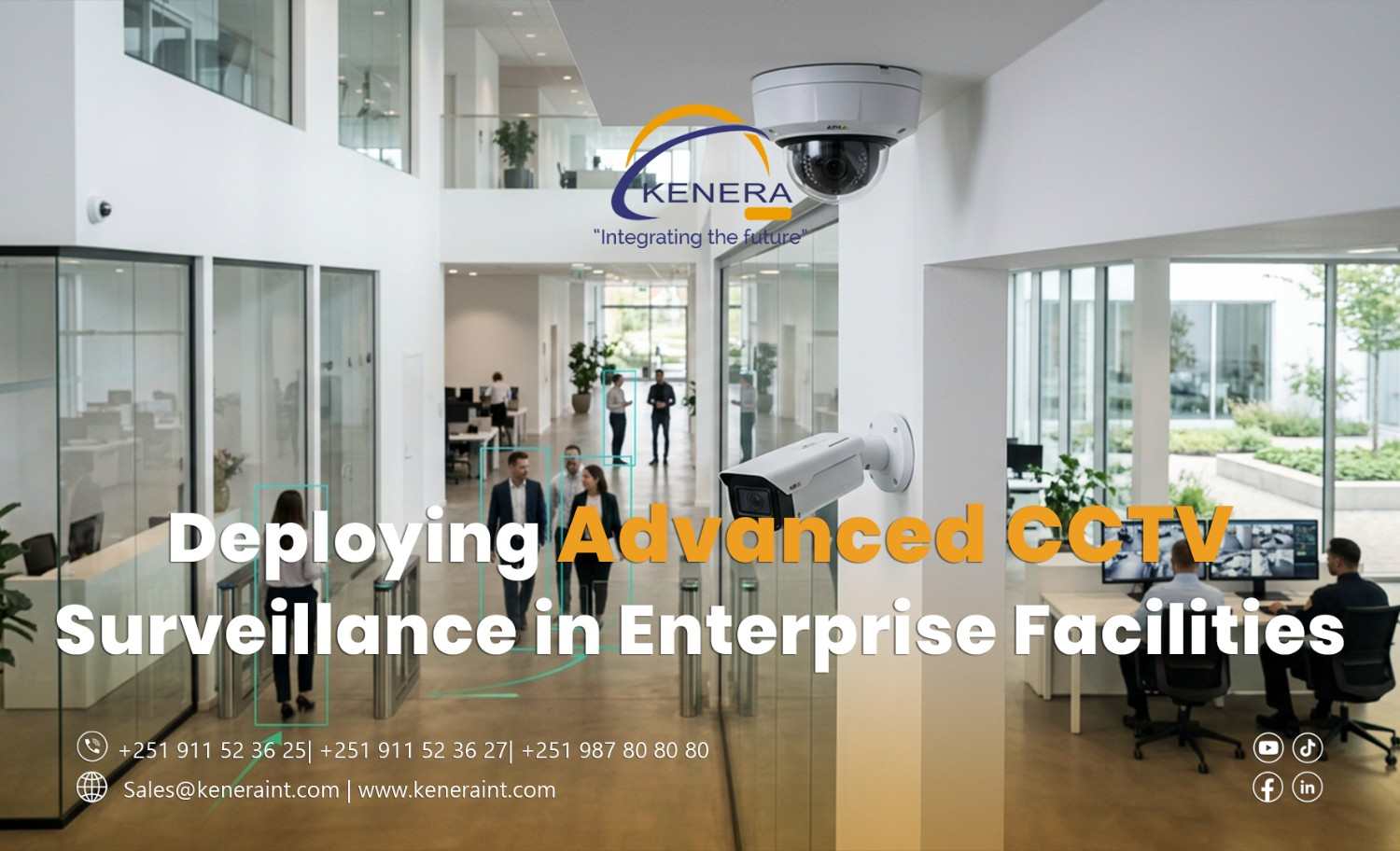
Deploying Advanced CCTV Surveillance in Enterprise Facilities
Enterprise facilities face increasingly complex physical security challenges. Corporate offices, data centers, banks, warehouses, manufacturing plants, healthcare facilities, and critical infrastructure sites must protect employees, valuable assets, sensitive areas, and business operations around the clock.
Modern enterprise CCTV surveillance has evolved far beyond simply recording video. Advanced systems combine high-resolution IP cameras, intelligent video analytics, centralized monitoring, secure networking, and access control integration to help organizations identify threats earlier and respond to incidents more effectively.
Effective enterprise surveillance is not about installing the largest number of cameras. It is about placing the right technology in the right locations and integrating it into a coordinated security environment.
Start With a Security Risk Assessment
Before selecting cameras or installing surveillance equipment, organizations should determine where monitoring is actually required and what security objective each camera must achieve.
A professional site assessment should evaluate areas such as:
- Building entrances and exits
- Perimeter boundaries
- Parking facilities
- Loading and delivery zones
- Server and technical rooms
- Warehouses and storage areas
- Restricted or high-security areas
- Other operationally critical locations
Each camera should have a clearly defined purpose. Some areas may require general activity monitoring, while others need accurate identification, intrusion detection, or continuous observation.
The objective is to achieve effective surveillance coverage with minimal blind spots while avoiding unnecessary equipment and complexity.
Select the Right CCTV Technology
Enterprise facilities rarely have identical surveillance requirements across every area. Different environments require different camera technologies depending on distance, lighting, field of view, environmental conditions, and security objectives.
Suitable for entrances, corridors, technical rooms, office areas, and locations where the surveillance field remains consistent.
Pan-Tilt-Zoom cameras provide broader coverage for compounds, parking facilities, industrial sites, and other large environments.
Designed to maintain useful visibility during nighttime or in areas where normal lighting conditions are limited.
Can provide additional detection capability for selected perimeter, industrial, and critical infrastructure applications.
Camera selection should consider resolution, viewing distance, lighting conditions, mounting position, environmental exposure, and the purpose of surveillance at each location.
Use Intelligent Video Analytics
One of the most significant advancements in modern CCTV infrastructure is the use of AI-powered video analytics.
Traditional surveillance often requires operators to continuously watch numerous video feeds. In a large enterprise environment, this becomes difficult to sustain effectively.
Intelligent analytics can automatically identify predefined events and bring potentially important activity to the attention of security personnel.
Video analytics transforms CCTV from a largely passive recording system into a more proactive security monitoring tool.
Integrate CCTV With Access Control
CCTV becomes significantly more valuable when it operates alongside other physical security technologies.
Integrating CCTV surveillance with access control systems gives security personnel greater context when investigating access events.
For example, when a credential is used to enter a restricted area, the access event can be associated with corresponding video footage.
This can help security teams investigate:
- Denied access attempts
- Forced-door events
- Unauthorized entry
- Tailgating
- Suspicious activity around restricted locations
For data centers, banks, government facilities, corporate campuses, and other high-security environments, this integration can significantly improve incident verification and investigation.
Secure the CCTV Network
Modern IP cameras are network-connected devices. This means surveillance infrastructure must be treated as part of the organization's broader cybersecurity environment.
Poorly secured cameras or management platforms can create unnecessary security exposure.
CCTV infrastructure should never become an overlooked entry point into the wider enterprise network.
Plan Network Capacity Carefully
High-resolution IP cameras can generate substantial network traffic, especially when an enterprise operates hundreds of cameras continuously.
Network architecture should therefore account for camera resolution, frame rates, compression, concurrent streams, recording requirements, available bandwidth, and future expansion.
Centralize Monitoring and Video Management
Large organizations need more than individual camera interfaces. A centralized Video Management System (VMS) provides a unified platform for managing surveillance operations.
A properly designed VMS can bring key surveillance functions together in one operational environment.
For enterprises operating multiple branches, campuses, warehouses, or facilities, centralized surveillance can provide greater operational visibility and help security teams maintain more consistent monitoring across locations.
Build a Smarter Enterprise Security Environment
Advanced CCTV delivers the greatest value when it operates as part of a broader integrated security ecosystem rather than as an isolated camera network.
Connecting these technologies allows enterprises to move beyond basic video recording toward proactive and coordinated security monitoring.
Enterprise Surveillance Solutions with Kenera International
Deploying an advanced surveillance environment requires more than purchasing cameras. Camera positioning, network infrastructure, storage capacity, analytics, security integration, and centralized management must work together as one coordinated system.
Kenera International supports organizations in designing and deploying integrated ICT and physical security infrastructure built around reliability, scalability, security, and real-world enterprise requirements.
From enterprise CCTV and intelligent video surveillance to access control, networking, infrastructure integration, and centralized monitoring, we help organizations build security environments designed to protect critical people, facilities, and operations.
Conclusion
Modern enterprise surveillance is no longer simply about recording what happened. Organizations increasingly need security infrastructure capable of providing visibility, identifying suspicious events, supporting rapid investigations, and integrating with wider physical and digital security systems.
A successful deployment begins with a security risk assessment and continues through careful camera selection, intelligent analytics, access control integration, secure networking, centralized video management, and proper infrastructure planning.